
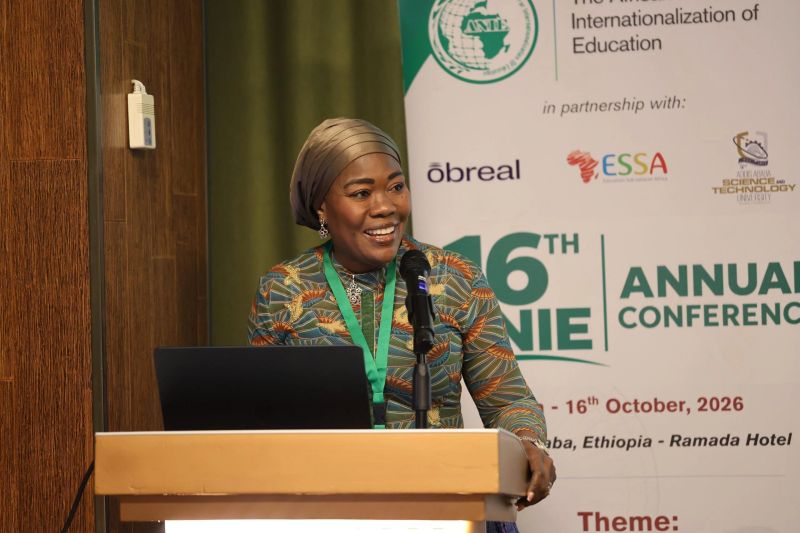
ADDIS ABABA, Ethiopia — Higher education leaders, researchers, policy makers, and internationalization practitioners from across Africa and beyond converged in Addis Ababa for the official opening of the 16th Annual Conference of the African Network for Internationalization of Education (ANIE).
Hosted at the Addis Ababa Science and Technology University (AASTU) in partnership with OBREAL Global and Education Sub Saharan Africa (ESSA), this year’s conference is centered around a critical and timely theme: “Building Resilient Knowledge Ecosystems in Africa.”
A Call for African Agency and Leadership
Delivering the official opening remarks, Prof. Goski Alabi, Chairperson of the ANIE Board, set an ambitious tone for the three-day gathering. She welcomed delegates to the home of the African Union, extending a special acknowledgment to postgraduate students and early-career researchers—including representatives from NECREDI—noting that their leadership is vital to shaping the continent’s future.
Prof. Alabi challenged participants to look beyond mere institutional survival and resource constraints. She emphasized that true resilience must go hand in hand with authentic African agency and a level playing field in global knowledge diplomacy.
“Our theme invites us to ask a fundamental question: how can African institutions acquire the capacity not merely to participate in global knowledge systems, but to shape, sustain and lead them?” noted Prof. Alabi. “Our ambition is not to disengage from the world. It is to engage more confidently and equitably: to move from participation to leadership, from dependency to reciprocity.”
Key Focus Areas Across the Three-Day Programme
The conference programme is structured to take delegates from foundational critique to strategic action:
- Day One – Interrogating the Foundations of Resilience: Sessions tackle the core mechanics of equity, power dynamics in research partnerships, policy coherence, and African ownership of knowledge creation.
- Day Two – Capabilities, Education, and Innovation: Discussions shift toward empowering the people who sustain knowledge systems—focusing on postgraduate supervision, mentoring emerging scholars, digital collaboration, and ensuring African institutions act as designers and contributors—rather than mere consumers—of technological innovation.
- Day Three – From Deliberation to Strategic Commitment: The final day will address institutional governance, equity choices, and high-level leadership reflections to map out actionable takeaways for ANIE and its network partners.
Three Challenges for Delegates
In her concluding charge, Prof. Alabi left attendees with three core challenges to carry through their deliberations:
- Identify the specific institutional capabilities required for resilience, rather than just cataloging vulnerabilities.
- Evaluate international partnerships based on reciprocity, African leadership, and enduring mutual benefits.
- Translate conference discussions into practical, sustained commitments that outlive the Addis Ababa gathering.
The 16th ANIE Annual Conference runs from October 14 to 16, 2026, promising robust dialogue and impactful pathways toward strengthening Africa’s higher education landscape.